2005: Question 2 - deconstructed response about marketing from The Onion
I would have answered this question by discussing the mocking tone that comments on how gullible consumers are, and how the media and advertising uses gaudy and impressive language to convince consumers to buy a product they don't really need. The article exaggerates the issues one could possibly have with an ankle or a foot, and flat out makes up issues such as "the frequency of one's foot is out of alignment with the Earth," and then exaggerates the positive effect this product could have. The article also employs the use of quotations from a customer, mocking the American consumers even further. The article as a whole warns the general public against these marketing ploys through its use of humor, exaggeration, and clearly made-up facts and statements.
Sample essays:
failures:
-"subtle jokes"
-focused more on satire itself (definition), not how the satire portrayed marketing and consumers
-not enough analysis
successes:
-embedded quotes well, paired with impressive analysis
-references to outside events or people
Like one of the successful sample essays I would have focused most of my argument by embedding quotes from the passage and analyzing their ridiculousness and how they satirize consumers and marketing techniques. Unlike any of the sample essays I would have also commented on human nature and how we as humans always want the "next best thing," and always want more, even if we do not need it. I would then tie this to marketing and how even ridiculous ads are successful, because consumers are gullible and will buy cool, new products, because they sound too good to be true (and are indeed too good to be true).
I believe I would have been successful on this prompt. I chose it because I saw "satire," which is something I have never been good at recognizing, nor writing about. But in this article the satire was painstakingly obvious, and the moral implications displayed were also made clear.
Tuesday, May 7, 2013

Monday, March 18, 2013
HOD - Confusing Passage
On page 108 and 109 Marlow describes the black men that were with him on the steamboat as they sail in the river to Kurtz. First he states that the men "were not inhuman.They howled and leaped, and spun, and made horrid faces; but what thrilled you was just the thought of their humanity - like yours - the thought of your remote kinship with this wild and passionate uproar." Here he recognizes their humanity, but then he questions it and reflects on the trouble white men have of recognizing it. Does Marlow still think he is superior or is he feeling a connection to the natives? Is he recognizing that they act more primitively, but at the heart of it all, they are similar?
It seems like he is enlightened by this experience but then he includes a rather comical and demeaning description of the "savage who was fireman...He was there below me, and, upon my word, to look at him was as edifying as seeing a dog in a parody of breeches and a feather hat, walking on his hind-legs." Here he refers to the black man as a dog, clearly not an indication of his belief that the natives possess humanity. So at this point in the book, how does Marlow view the Africans he encounters?
It seems like he is enlightened by this experience but then he includes a rather comical and demeaning description of the "savage who was fireman...He was there below me, and, upon my word, to look at him was as edifying as seeing a dog in a parody of breeches and a feather hat, walking on his hind-legs." Here he refers to the black man as a dog, clearly not an indication of his belief that the natives possess humanity. So at this point in the book, how does Marlow view the Africans he encounters?
Monday, March 11, 2013
Heart of Darkness quote
"They were conquerors, and for that you want only brute force - nothing to boast of, when you have it, since your strength is just an accident arising from the weakness of others" (69-70).
In this passage the narrator is discussing the actions of Europeans in Africa. He calls them "conquerors," implying that their motives were almost warlike; they went in to exploit, to pillage, and plunder. They did not go their with the intention of killing, but killing was just the consequence. In this case, the narrator states it was the consequence of the Africans' savagery, their inherent "weakness." In a sense this dehumanizes them, saying that they were like wild animals, needing a strong hand, and "brute force." He goes as far as calling their brutality an accident, somewhat justifying their action and pinning the blame on the Africans themselves, the true victims in the whole situation. As we know, the Europeans went quite overboard with their force, exterminating millions of Africans along the way for their own selfish desires.
In this passage the narrator is discussing the actions of Europeans in Africa. He calls them "conquerors," implying that their motives were almost warlike; they went in to exploit, to pillage, and plunder. They did not go their with the intention of killing, but killing was just the consequence. In this case, the narrator states it was the consequence of the Africans' savagery, their inherent "weakness." In a sense this dehumanizes them, saying that they were like wild animals, needing a strong hand, and "brute force." He goes as far as calling their brutality an accident, somewhat justifying their action and pinning the blame on the Africans themselves, the true victims in the whole situation. As we know, the Europeans went quite overboard with their force, exterminating millions of Africans along the way for their own selfish desires.
Tuesday, February 26, 2013
It's Seriously Screwed Up
Not to be dramatic.. but reading King Leopold's Ghost has made me incredibly disappointed with our own nation and all of the other European nations that stood idly by while Africans were exploited, tortured, and killed, for economic gain, just as the US forced Native Americans on the Trail of Tears towards reservations, and took their land through deception. From various history classes, I have gained an insight into conquest, war, and colonization, mostly from the victors perspective. But KLG took all of this to a completely different level that includes psychological, emotional, and physical torment. "Each time that the torturer lifts up the chicotte, a reddish stripe appears on the skin of the pitiful victims, who, however firmly held, gasp in frightful contortions...At the first blows the unhappy victims let out horrible cries which soon become faint groans...in a refinement of evil, some officers demand that when the sufferer gets up, panting, he must graciously give the military salute (121)" the dehumanization, the physical abuse including harsh forced labor, beatings, mutilation, and outright murder, and the psychological effect of separating families goes far beyond a desire for just exploration and conquest. It seems unfathomable for any motive, yet somehow a deeply rooted greed for profit and power moved the white men to lose their "civilized" ways and act like the very savages they were supposedly trying to help.
Although it seems as if the European world is past their previous evil state, slavery and exploitation are still found in the modern world. In June 2012, a journalist reported on an instance of slavery in Brazil in the Amazon River region. Workers are told that they will be given paid work, but instead are taken deep into the forest and forced to cut down the forest to make charcoal under very harsh conditions, often without pay. Many are scared to escape, fearing that the armed guards will shoot them in the back. Thousands of people in brazil live in slavery and are put to work to gather resources that will be shipped and used in the United States. The Brazilian government has tried to address the problem, but in such a vast area, offenders are difficult to find. Instead, they will punish known offenders, and educate the population on how to find safe jobs. Couldn't they do more to stop this?
Another issue that surfaces largely in the book, is brutality and the enslavement of children. In West Africa, 109,000 children work in the production of cocoa, the main ingredient in chocolate, a common treat that is enjoyed around the world. Roughly 10,000 are victims of enslavement. Child labor is known to take place in many countries (China, India, Africa to name a few) that are our main sources of clothing production, and other resources. Female trafficking is also common in many parts of the world. These forms of abuse leave victims in fearless, powerless, and without a voice. Who can help? Perhaps the better question is, who WILL help?
I am sure that the majority of Americans, normal citizens and great politicians, can agree that exploitation is horrible. Yet few of us are willing to give up basic commodities, and luxuries, that are provided for us by the enslavement of men, women, and children, abroad. Perhaps there is no greater call to action because the offenses are not occurring close to home. We have reaped the benefits of exploitation, often times knowingly, since the brutality and harsh labor occurs not within our own borders, but within those of the third world.

Although it seems as if the European world is past their previous evil state, slavery and exploitation are still found in the modern world. In June 2012, a journalist reported on an instance of slavery in Brazil in the Amazon River region. Workers are told that they will be given paid work, but instead are taken deep into the forest and forced to cut down the forest to make charcoal under very harsh conditions, often without pay. Many are scared to escape, fearing that the armed guards will shoot them in the back. Thousands of people in brazil live in slavery and are put to work to gather resources that will be shipped and used in the United States. The Brazilian government has tried to address the problem, but in such a vast area, offenders are difficult to find. Instead, they will punish known offenders, and educate the population on how to find safe jobs. Couldn't they do more to stop this?
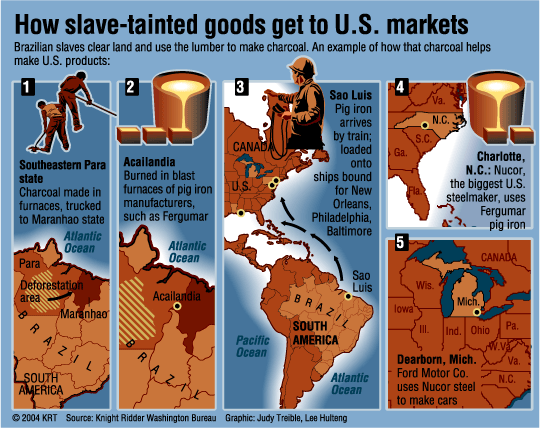
Another issue that surfaces largely in the book, is brutality and the enslavement of children. In West Africa, 109,000 children work in the production of cocoa, the main ingredient in chocolate, a common treat that is enjoyed around the world. Roughly 10,000 are victims of enslavement. Child labor is known to take place in many countries (China, India, Africa to name a few) that are our main sources of clothing production, and other resources. Female trafficking is also common in many parts of the world. These forms of abuse leave victims in fearless, powerless, and without a voice. Who can help? Perhaps the better question is, who WILL help?
I am sure that the majority of Americans, normal citizens and great politicians, can agree that exploitation is horrible. Yet few of us are willing to give up basic commodities, and luxuries, that are provided for us by the enslavement of men, women, and children, abroad. Perhaps there is no greater call to action because the offenses are not occurring close to home. We have reaped the benefits of exploitation, often times knowingly, since the brutality and harsh labor occurs not within our own borders, but within those of the third world.
Tuesday, February 19, 2013
KGL Chapter 3
The Magnificent Cake
This chapter is dedicated to describing Stanley's exploration from the east to the west coast of Africa. On page 49, we hear about Stanley's brutality with native Africans. They describe him as practically feasting on death and fighting for the sole purpose of drawing blood, "We have attacked and destroyed 28 large town and three or four score villages." Humanitarian groups, Aborigines Protection Society and the Anti-Slavery Society sure thought Stanley was evil, saying that he "shoots negroes as if they were monkeys." Why would he do this when he was on an expedition? To establish dominance? Or did he feel threatened, and so fought out of protection or self defense? Clearly the native's primitive bows and arrows were no match for European rifles. One would think that his presence would be enough to intimidate the Africans, so was Stanley fighting simply to kill?
As a journalist, Stanley wrote many accounts of his trip. His first book was titled Through the Dark Continent. Other volumes were titled In Darkest Africa and My Dark Companions and Their Strange Stories. How are these titles significant and representative of Stanley's feelings, and that of other Europeans, regarding Africa and its people? Since Stanley's 3 white companions all died before the end of the expedition, there is no way to know if his account is truthful. As we know, Stanley wasn't the most emotionally stable guy, so some of it must have been exaggerated, but which parts are most likely to have been romanticized? What picture was he trying to paint for people back in Europe?
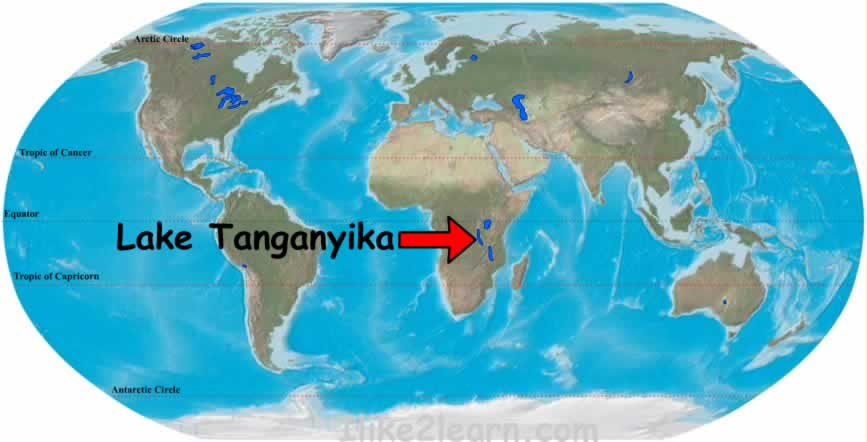
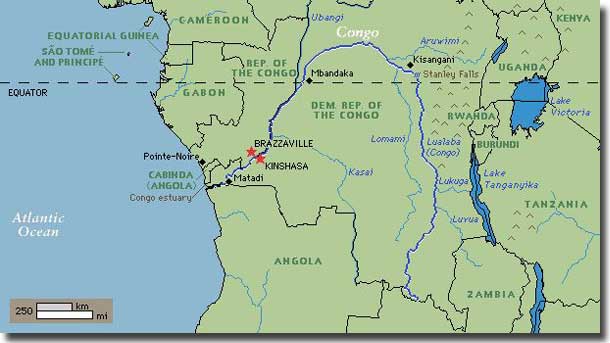
After finding Livingston at Lake Tanganyika on the east, then followed a river known by the locals as the Lualaba. He suspected that it was either the Congo River or the Nile. An article from the Daily Telegraph comments on his findings. He found that the Congo River curves as if its shape is a semicircle, so part of the top half is above the equator, and the rest of below. Because of its proximity to the equator, the region is dominated by sharp differences in weather, when it is rainy above the line, it is dry below. The last part of his journey was through the rainy season. Many died from starvation and disease, others went crazy.
Quiz Questions
1. In some parts of Stanley's records he reflects on himself as if speaking as an African native:
"How can he be a good man who comes for no trade, whose feet you never see, who always goes covered with clothes, unlike all other people? No, there is something very mysterious about him, perhaps wicked, perhaps he is a magician, at any rate it is better to leave him alone and not disturb him" (53).
In these moments, was Stanley experiencing true guilt? Was he actually recognizing how wicked his actions were?
2. When Stanley returned from his trip he condemned the Arab slave trade, voiced his desire to convert the Africans, and discussed "the general indecency of their nakedness," as if wanting to enlighten and uplift the continent (57). Was he speaking the truth? Or was he really more focused on the economic potential he saw in Africa? What was in it for him?
3. What were Stanley's true motives for exploring Central Africa?
4. Why were the English uninterested in Africa?
5. How did Stanley affect King Leopold's desire for Africa? How does it relate to the title of the chapter, "The Magnificent Cake?"
This chapter is dedicated to describing Stanley's exploration from the east to the west coast of Africa. On page 49, we hear about Stanley's brutality with native Africans. They describe him as practically feasting on death and fighting for the sole purpose of drawing blood, "We have attacked and destroyed 28 large town and three or four score villages." Humanitarian groups, Aborigines Protection Society and the Anti-Slavery Society sure thought Stanley was evil, saying that he "shoots negroes as if they were monkeys." Why would he do this when he was on an expedition? To establish dominance? Or did he feel threatened, and so fought out of protection or self defense? Clearly the native's primitive bows and arrows were no match for European rifles. One would think that his presence would be enough to intimidate the Africans, so was Stanley fighting simply to kill?
As a journalist, Stanley wrote many accounts of his trip. His first book was titled Through the Dark Continent. Other volumes were titled In Darkest Africa and My Dark Companions and Their Strange Stories. How are these titles significant and representative of Stanley's feelings, and that of other Europeans, regarding Africa and its people? Since Stanley's 3 white companions all died before the end of the expedition, there is no way to know if his account is truthful. As we know, Stanley wasn't the most emotionally stable guy, so some of it must have been exaggerated, but which parts are most likely to have been romanticized? What picture was he trying to paint for people back in Europe?

After finding Livingston at Lake Tanganyika on the east, then followed a river known by the locals as the Lualaba. He suspected that it was either the Congo River or the Nile. An article from the Daily Telegraph comments on his findings. He found that the Congo River curves as if its shape is a semicircle, so part of the top half is above the equator, and the rest of below. Because of its proximity to the equator, the region is dominated by sharp differences in weather, when it is rainy above the line, it is dry below. The last part of his journey was through the rainy season. Many died from starvation and disease, others went crazy.

Quiz Questions
1. In some parts of Stanley's records he reflects on himself as if speaking as an African native:
"How can he be a good man who comes for no trade, whose feet you never see, who always goes covered with clothes, unlike all other people? No, there is something very mysterious about him, perhaps wicked, perhaps he is a magician, at any rate it is better to leave him alone and not disturb him" (53).
In these moments, was Stanley experiencing true guilt? Was he actually recognizing how wicked his actions were?
2. When Stanley returned from his trip he condemned the Arab slave trade, voiced his desire to convert the Africans, and discussed "the general indecency of their nakedness," as if wanting to enlighten and uplift the continent (57). Was he speaking the truth? Or was he really more focused on the economic potential he saw in Africa? What was in it for him?
3. What were Stanley's true motives for exploring Central Africa?
4. Why were the English uninterested in Africa?
5. How did Stanley affect King Leopold's desire for Africa? How does it relate to the title of the chapter, "The Magnificent Cake?"
Friday, February 8, 2013
cash, control... and compassion?
Although colonialism and imperialism seem to be two very similar terms, colonialism refers to the settlement of one country (or parts of it) by another, while imperialism is the economic and/or political control of a country by another. Both are driven by a desire for economic prosperity and power. Beginning with the Ancient Greeks, numerous superpowers began establishing colonies abroad to stimulate trade by establishing oversees markets for imports and exports. During the time of the Industrial Revolution, European nations, especially Great Britain looked outside of its realm for markets and raw materials, thus leading to an increase in European colonization of other lands. The colonization in turn brought Europe great wealth, and with such wealth comes power. They acquired great power in the form of respect and admiration from other nations, and they struck fear in the hearts of the indigenous population, who they could in turn exploit without limits. Eventually, the American Revolution came around, Britain lost its North American colonies, so it began to turn its attention to other more “primitive” lands.
Europeans soon began to establish a presence in Africa. As its markets were expanding, goods were being produced rapidly, so they needed a good, cheap labor force. So in the 18th and 19th centuries, Europe got involved in the slave trade, as part of the triangular trade route between Africa, Europe, and North America. Europe then realized that its own natural resources were depleted, and Africa was rich with useful raw materials. This was incredibly beneficial to wealthy nations, as it was cheap to gather the materials since they would exploit the indigenous people, and they acquired everything they needed for their own markets. At the time, France was also interested in Africa as a way to redeem itself after being defeated at Waterloo in 1815 . European pride certainly compromised their morals as they began to exploit the indigenous Africans without mercy. One of the most lucrative natural resources was rubber, and diamonds, now a very controversial gem.
Although most of colonization and imperialism was driven by a desire for land, natural resources, power, and wealth, the British developed a different reason behind imperialism. In 1899 Rudyard Kipling, a British poet, wrote a poem titled “The White Man’s Burden.” Basically, they believed that it was their duty, and a somewhat heavy burden, to take control of other countries politically, in order to enlighten them and teach them how to be civilized, steering them away from savagery. This seemingly “humanitarian” approach appears to have been nothing but a justification for their deeply entrenched greed that would be fulfilled no matter what stood in their way.
Friday, February 1, 2013
Senior Project/Paper
I completed the main part of my senior project in the summer. In early June, I spent one week in the Dominican Republic, in a medical and dental clinic, volunteering as a translator for a pediatrician. The first day, we spent a few hours setting up the clinic, stocking the pharmacy, cleaning, etc. Then, for three days, I worked with the pediatrician, acting as the only bridge of communication between the doctor and the patient. After each patient, I recorded age, symptoms, ethnicity (Haitian or Dominican), and final diagnosis. At first, it was difficult to understand the patient, especially since the Dominican dialect is different to the Spanish I am used to hearing and speaking at home. However, once I became more comfortable, I was able to effectively communicate between the patient and the doctor, to help figure out what was wrong with the patient's health. I also contributed by instructing the patient on how to use/take the medicine the doctor prescribed them.
For my senior project paper, I wrote about health in the Dominican Republic with an emphasis on rural health, (since I was working in a small village in the mountains). At first it was difficult to find information about it, but then I began to search more specific issues, such as infectious diseases, and the nation's water supply. I also found two books at the Napa library that were helpful in describing typical Dominican life. The World Health Organizatin also had many useful statistics about numerous aspects of the health situation. Once I got enough information about health in the Dominican Republic, my paper came together quite smoothly. I suppose I could have searched for more articles from books or magazines, further in advance to have made the research process smoother.
The research I found was also very interesting because it coincided with my own observations of rural areas. A lot of the research I found was about the nation's contaminated water supply and the mosquito-borne diseases that arise from it. Sure enough when I was in the DR we could not drink the water, and all the volunteers had to take chloroquine weeks before arriving and a few weeks upon returning to the United States.
For my senior project paper, I wrote about health in the Dominican Republic with an emphasis on rural health, (since I was working in a small village in the mountains). At first it was difficult to find information about it, but then I began to search more specific issues, such as infectious diseases, and the nation's water supply. I also found two books at the Napa library that were helpful in describing typical Dominican life. The World Health Organizatin also had many useful statistics about numerous aspects of the health situation. Once I got enough information about health in the Dominican Republic, my paper came together quite smoothly. I suppose I could have searched for more articles from books or magazines, further in advance to have made the research process smoother.
The research I found was also very interesting because it coincided with my own observations of rural areas. A lot of the research I found was about the nation's contaminated water supply and the mosquito-borne diseases that arise from it. Sure enough when I was in the DR we could not drink the water, and all the volunteers had to take chloroquine weeks before arriving and a few weeks upon returning to the United States.
Research Paper Q & A
1. My topic is the contoversy over embryonic stem cell research. There are many religious and ethical reasons that people oppose embryonic stem cells. The use of adult stem cells and stem cells from umbilical cord blood seem to be a solution to the embryonic stem cell debate, yet many people oppose stem cell research as a whole, even if it is not harming embryos.
2. Sevearl sources fully encompass the arguments of both sides on the issue. This is very useful as it illustrates the pros and cons of embryonic stem cells. Other articles are also useful in showing that embryonic stem cells have already proven themselves as helpful to improving the lives of animals, showing promise for use in humans.
3. I believe that stem cell research, embryonic stem cells and adult stem cells, will be very useful to humans. I also feel that the procedures to extract stem cells are quite ethical, despite opponents' complaints. Scientists use cells from embryos that would be discarded anyway. Why not use them to save someone's life?
4. I will explain the differences between embryonic stem cells and adult stem cells. Many terms are quite difficult and are certainly not common knowledge, so I will devote part of my paper to introduce the science behind stem cells. For example, embryonic stem cells are more useful because they are pluripotent: they can become any type of cell. Adult stem cells are multipotent: they can be induced to beome some of the body's cell types.
5. One article talked about Harvard researchers who built a cow's kidney from embryonic stem cells. That kidney was then able to successfully produce urine. Surely this could be applied to humans, and provide healthy organs for people needing a transplant. Embryonic stem cells have so much potential for cures!
2. Sevearl sources fully encompass the arguments of both sides on the issue. This is very useful as it illustrates the pros and cons of embryonic stem cells. Other articles are also useful in showing that embryonic stem cells have already proven themselves as helpful to improving the lives of animals, showing promise for use in humans.
3. I believe that stem cell research, embryonic stem cells and adult stem cells, will be very useful to humans. I also feel that the procedures to extract stem cells are quite ethical, despite opponents' complaints. Scientists use cells from embryos that would be discarded anyway. Why not use them to save someone's life?
4. I will explain the differences between embryonic stem cells and adult stem cells. Many terms are quite difficult and are certainly not common knowledge, so I will devote part of my paper to introduce the science behind stem cells. For example, embryonic stem cells are more useful because they are pluripotent: they can become any type of cell. Adult stem cells are multipotent: they can be induced to beome some of the body's cell types.
5. One article talked about Harvard researchers who built a cow's kidney from embryonic stem cells. That kidney was then able to successfully produce urine. Surely this could be applied to humans, and provide healthy organs for people needing a transplant. Embryonic stem cells have so much potential for cures!
Monday, January 28, 2013
Dominated by the prefrontal cortex
Since the prefrontal cortex of the brain is not yet fully developed middle schoolers and high schoolers do not make the best decisions. Our lives and actions are driven by pure and raw emotion. The brain makes neural connections because the brain is still in the process of adding myelin, and we also cannot make connections between an action and its subsequent consequences. Judgement is impaired, but we can't really help it, can we? I can recall doing certain things and after being asked "why?" I really did not have an answer. Actions become impulses that lack a prior though process. This can perhaps explain why so many teens rebel with alcohol or drugs, or get tattoos. "It seemed like a good idea at the time" or "this is what I want right now, so I'm going to do it" are common justifications for reckless, thoughtless actions during adolescence.
More specific to girls is drama, drama, and more drama. Like the article says, "the brain is buzzing with dopamine" so everything is intensified. Girls get upset over a "mean look" from another girl and let that one small thing ruin their day. Then, since they're emotional, they commonly act rashly and bratty towards other girls, and then the feeling's of the other girls are hurt. It's a vicious cycle courtesy of the prefrontal cortex.
In terms of adolescent boys, the "more primitive" part of the brain will dominate action. In sports boys become aggressive, trying to show off how "macho" and strong they are. Emotionally, many will also do this for approval from their peer group and from girls. The emotional high they experience is probably also the reason behind many fights. This is sparked by trying to prove their "manhood" they have newly grown into, and their newfound pride.
With so many hormonal changes, on top of the not yet developed brain, adolescents are in a difficult and confusing time and may do outright stupid things. Hopefully we grow out of it someday.
More specific to girls is drama, drama, and more drama. Like the article says, "the brain is buzzing with dopamine" so everything is intensified. Girls get upset over a "mean look" from another girl and let that one small thing ruin their day. Then, since they're emotional, they commonly act rashly and bratty towards other girls, and then the feeling's of the other girls are hurt. It's a vicious cycle courtesy of the prefrontal cortex.
In terms of adolescent boys, the "more primitive" part of the brain will dominate action. In sports boys become aggressive, trying to show off how "macho" and strong they are. Emotionally, many will also do this for approval from their peer group and from girls. The emotional high they experience is probably also the reason behind many fights. This is sparked by trying to prove their "manhood" they have newly grown into, and their newfound pride.
With so many hormonal changes, on top of the not yet developed brain, adolescents are in a difficult and confusing time and may do outright stupid things. Hopefully we grow out of it someday.
Saturday, January 26, 2013
Watch out, Freshman Fifteen's coming for you!
College is right around the corner for all of us. The late night studying, the stress, the parties, the people, all of it is new and exciting. Will I like my roommate? Will my professors be cool and interesting? Will it really be that hard? Will I pass my classes? All of these questions come to mind when I think of college. But unfortunately another revolves around college cafeterias. Will I be a victim of the Freshman Fifteen? Dun dun dun dun…
According to WebMD, nearly one of every four freshman students gain approximately ten pounds during the first semester of college. Frightening? Yes. When one questions the reasons behind this it seems pretty obvious. First of all, if you’re really pushing to get A’s, most likely you will be spending most of your time in the library studying when you’re not in class. That doesn’t leave a whole lot of room for exercise. A lot of high school students play sports, but not many continue on to collegiate athletics. This could happen to many of us, high school athletes, whose bodies are used to having exercise to count on to metabolize food such as carbs that fuel and replenish our muscles.
Another obvious source of weight gain is bad eating habits. As stated in the article College Cafeteria Food: The Good, the Bad, and the Ugly, College cafeteria food commonly includes all-you-can-eat soda, hamburgers, grilled cheese sandwiches, french fries, and large selections of desserts. Although healthier foods are offered, when you’re stressed out and tired, would you want to eat a healthy salad? More often than not, the answer is no. Comfort food such as pizza or cookies are the first pick. Having the freedom to choose what you want and when you want it, is also risky. Irregular schedules contribute to the mix: a slice of pizza is quicker than eating a salad. Also due to irregular sleep patterns, many college students skip breakfast. Research has shown that this encourages the brain to crave higher-calorie foods.
Another source that many do not consider, is the ingestion of alcohol. Partying in college is common, and it is said that almost everyone does it. Therefore almost everyone is subject to the hidden source of weight gain. Not only does alcohol add on calories to your daily intake, it has been found that alcohol halts “lipid oxidation,” so basically it makes it difficult for the body to burn fat.
Although the “freshman fifteen” is a commonly feared part of college, other studies show that it is not necessarily something to be feared. Jay Zagorsky, a research scientist, found that on average, women gained only 3.1 pounds, and men gained 3.5 pounds within the first year. Only 10% of freshman gain 15 pounds or more, and 25% lose weight!
As we embark on our college journey, let’s hope that we keep our exercise and eating habits in check, and stay out of that 10%!
Tuesday, January 15, 2013
A Necessary Sacrifice?
On September 11, I was in 1st grade. So of course, I don't have a great recollection of what life was like before 9/11. At that age, one does not take note of racial profiling or recognize it when it occurs. A first grader wouldn't know much about the government either. The only real memories I have of pre 9/11 involve airport security. I remember how easy security was. But now, post 9/11 flying is a hassle. Packing is a challenge within itself, having to place all liquids in plastic bags and no large liquids passing through security. All coats, sweatshirts, shoes, belts and watches must be removed.
Before 9/11 I had never feared plane rides in any way. The only real plane disaster I had ever heard of was regarding Amelia Earhart. However, after, I found myself judging everyone on the plane ride with me. I had indeed feared the Arab and Muslim men that sat a few rows away from me.
Despite the current hassle, I have come to question how effective airport security was prior to the stricter standards. If the current standards were in palce before, would the 9/11 terrorists have been caught? Of course these answers cannot truly be answered, but with the extra long lines at security, and the more in-depth searches, comes a sense of comfort. Even though it's a headache, it is always comforting to know that the government is being extra cautious.
The Patriot Act is another example of a government precaution that is very controversial. Yes it may hinder thought, learning, writing, or expression. And yes an innocent person's privacy may be breached. If my online research was watched and I was ultimately contacted by the government, of course it would be nerve-racking and annoying. However, I would leave the situation sufficiently pleased that the government is doing it's job.
Although I believe that the tightening of national security is a good thing, racial profiling is indeed unfair. Unfortunately, it is difficult to avoid, especially after an event as severe as 9/11. I do believe that it is better to place harsher restrictions on everyone, instead of discriminating against one group. But then again, perhaps getting stopped and questioned, and missing a connection is a sacrifice for the greater good of national security and the well-being of the citizenry.
Before 9/11 I had never feared plane rides in any way. The only real plane disaster I had ever heard of was regarding Amelia Earhart. However, after, I found myself judging everyone on the plane ride with me. I had indeed feared the Arab and Muslim men that sat a few rows away from me.
Despite the current hassle, I have come to question how effective airport security was prior to the stricter standards. If the current standards were in palce before, would the 9/11 terrorists have been caught? Of course these answers cannot truly be answered, but with the extra long lines at security, and the more in-depth searches, comes a sense of comfort. Even though it's a headache, it is always comforting to know that the government is being extra cautious.
The Patriot Act is another example of a government precaution that is very controversial. Yes it may hinder thought, learning, writing, or expression. And yes an innocent person's privacy may be breached. If my online research was watched and I was ultimately contacted by the government, of course it would be nerve-racking and annoying. However, I would leave the situation sufficiently pleased that the government is doing it's job.
Although I believe that the tightening of national security is a good thing, racial profiling is indeed unfair. Unfortunately, it is difficult to avoid, especially after an event as severe as 9/11. I do believe that it is better to place harsher restrictions on everyone, instead of discriminating against one group. But then again, perhaps getting stopped and questioned, and missing a connection is a sacrifice for the greater good of national security and the well-being of the citizenry.
Subscribe to:
Comments (Atom)