Not to be dramatic.. but reading King Leopold's Ghost has made me incredibly disappointed with our own nation and all of the other European nations that stood idly by while Africans were exploited, tortured, and killed, for economic gain, just as the US forced Native Americans on the Trail of Tears towards reservations, and took their land through deception. From various history classes, I have gained an insight into conquest, war, and colonization, mostly from the victors perspective. But KLG took all of this to a completely different level that includes psychological, emotional, and physical torment. "Each time that the torturer lifts up the chicotte, a reddish stripe appears on the skin of the pitiful victims, who, however firmly held, gasp in frightful contortions...At the first blows the unhappy victims let out horrible cries which soon become faint groans...in a refinement of evil, some officers demand that when the sufferer gets up, panting, he must graciously give the military salute (121)" the dehumanization, the physical abuse including harsh forced labor, beatings, mutilation, and outright murder, and the psychological effect of separating families goes far beyond a desire for just exploration and conquest. It seems unfathomable for any motive, yet somehow a deeply rooted greed for profit and power moved the white men to lose their "civilized" ways and act like the very savages they were supposedly trying to help.
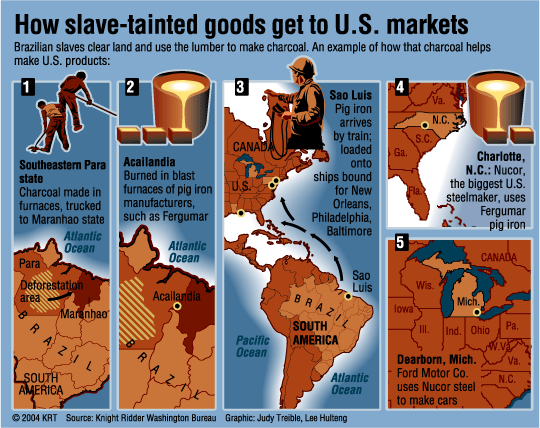
Although it seems as if the European world is past their previous evil state, slavery and exploitation are still found in the modern world. In June 2012, a journalist reported on an instance of slavery in Brazil in the Amazon River region. Workers are told that they will be given paid work, but instead are taken deep into the forest and forced to cut down the forest to make charcoal under very harsh conditions, often without pay. Many are scared to escape, fearing that the armed guards will shoot them in the back. Thousands of people in brazil live in slavery and are put to work to gather resources that will be shipped and used in the United States. The Brazilian government has tried to address the problem, but in such a vast area, offenders are difficult to find. Instead, they will punish known offenders, and educate the population on how to find safe jobs. Couldn't they do more to stop this?
Another issue that surfaces largely in the book, is brutality and the enslavement of children. In West Africa, 109,000 children work in the production of cocoa, the main ingredient in chocolate, a common treat that is enjoyed around the world. Roughly 10,000 are victims of enslavement. Child labor is known to take place in many countries (China, India, Africa to name a few) that are our main sources of clothing production, and other resources. Female trafficking is also common in many parts of the world. These forms of abuse leave victims in fearless, powerless, and without a voice. Who can help? Perhaps the better question is, who WILL help?
I am sure that the majority of Americans, normal citizens and great politicians, can agree that exploitation is horrible. Yet few of us are willing to give up basic commodities, and luxuries, that are provided for us by the enslavement of men, women, and children, abroad. Perhaps there is no greater call to action because the offenses are not occurring close to home. We have reaped the benefits of exploitation, often times knowingly, since the brutality and harsh labor occurs not within our own borders, but within those of the third world.


No comments:
Post a Comment